
Solana Alpenglow explained simply: what changed and what it means for stakers
In October 2026 Solana changed the way validators agree on blocks. Here is what Alpenglow is, why transactions now settle in a fraction of a second, and whether you need to do anything as a staker.
Updated November 21, 2026

Short answer for stakers: if your SOL is staked, you don't need to do anything. Your stake, your validator and your rewards stay where they are. Below is what changed and why it matters.
What Alpenglow is, in one paragraph
Thousands of validators run Solana, and for every block they need to agree: "yes, this block is correct, it is now final". The rules for reaching that agreement are called consensus. Alpenglow is Solana's new consensus, the biggest change to the network since its launch. It went live on mainnet on 21 October 2026, and it was designed to make agreement much faster and much cheaper.
An analogy: a newspaper vs a show of hands
Before (TowerBFT). Picture a committee where every member's vote is printed in the newspaper. To be sure a decision stands, you wait for several more issues to come out. It works, but it is slow, and most of the newspaper is filled with votes instead of news.
Now (Alpenglow). Committee members raise their hands in the room and tell each other directly. As soon as enough of them agree, the chair writes one short certificate: "decision accepted". The newspaper then prints only that one line.
That is essentially the change: votes stopped being "printed" into the blockchain and became quick direct messages between validators.
Change 1: transactions become final almost instantly
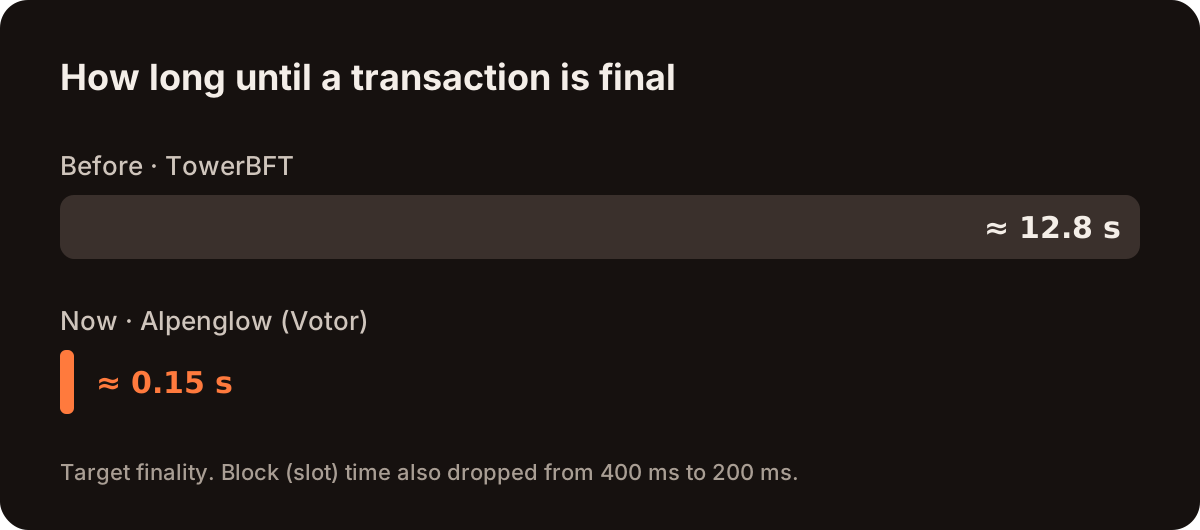
Finality is the moment a transaction can no longer be reversed.
Under the old system, a transaction became final after about 12.8 seconds. Alpenglow's target is about 150 milliseconds, roughly 99% faster. The 150 ms figure is a target that depends on network conditions, not a guarantee. The block time also changed: a slot used to last 400 ms and now lasts 200 ms.
For you this means exchanges, apps and wallets can treat your transaction as settled almost immediately, instead of making you wait.
Change 2: how validators vote now (Votor)
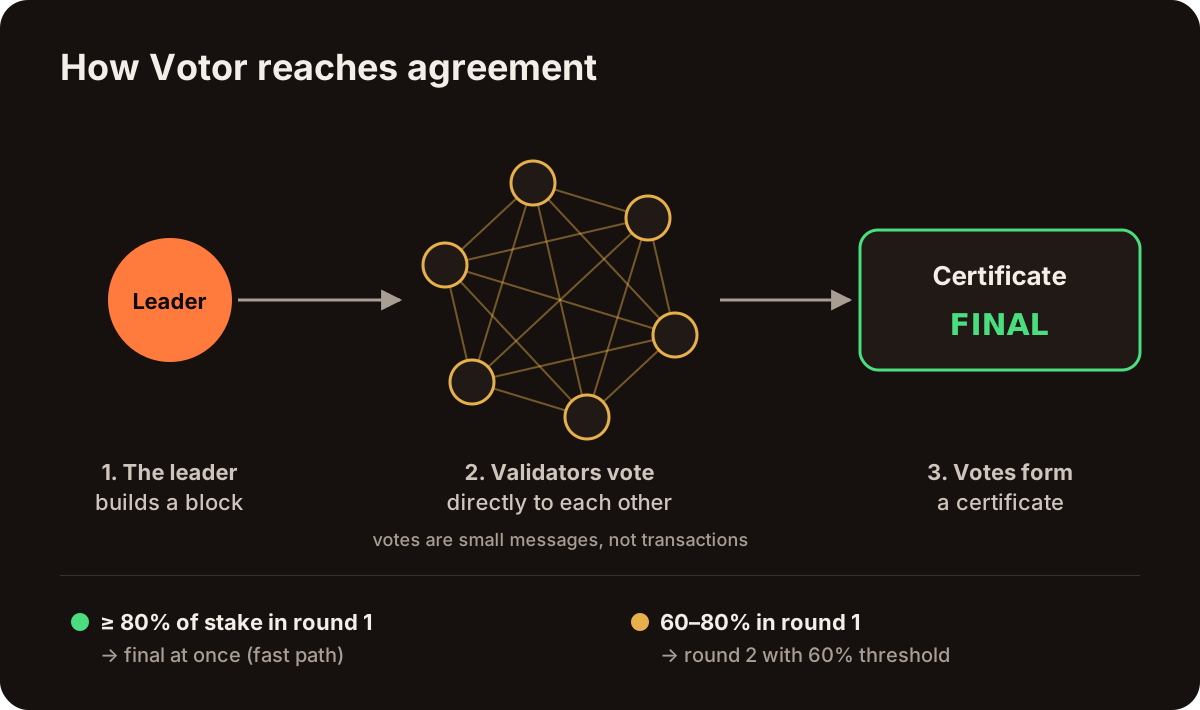
The new voting part of Alpenglow is called Votor.
- The leader (the validator whose turn it is) builds a block.
- The other validators check it and vote by sending each other short messages, not blockchain transactions.
- The votes are combined into a certificate. If validators holding 80% or more of all stake vote "yes" in the first round, the block is final at once. If support is between 60% and 80%, a second round runs with a 60% threshold.
Safety margin. The network keeps working even if 20% of stake belongs to attackers and another 20% is simply offline. Solana calls this the "20 + 20" model.
Change 3: blocks are freed from votes
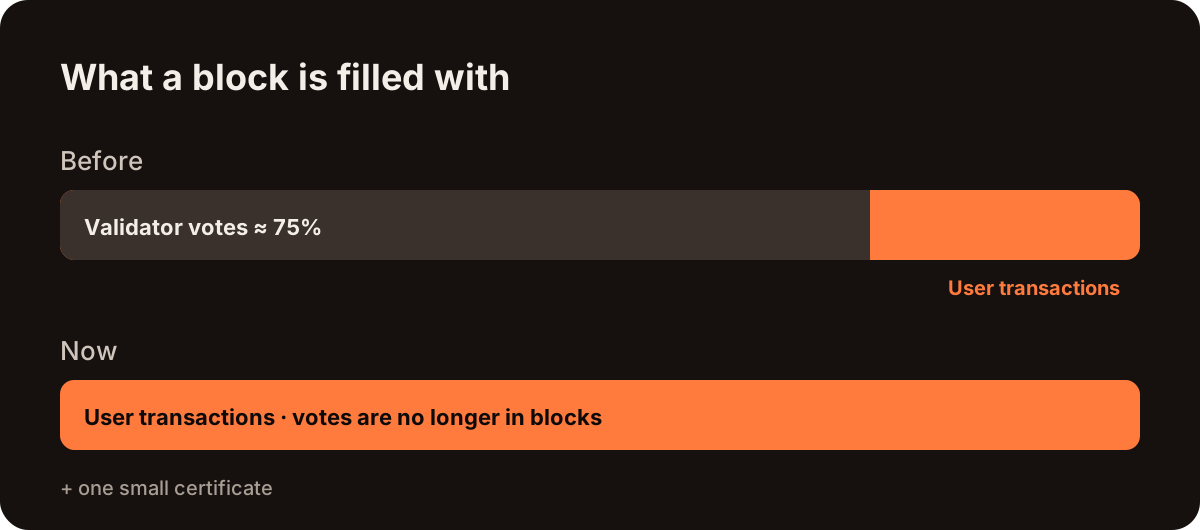
Only a small certificate goes into the block now, instead of thousands of separate votes.
Before Alpenglow, about three quarters of all Solana transactions were validator votes. Now votes don't appear in blocks at all. That frees space for ordinary users' transactions.
So if you see on a dashboard that Solana's "transactions per second" dropped sharply in October 2026, don't worry. This is an accounting change, not a slowdown: the votes simply stopped being counted as transactions.
What changed for validators
- No more vote fees. Under the old system, voting cost a validator about 1 SOL per epoch in fees. Now each validator pays a flat 0.8 SOL per epoch "admission ticket" (VAT), and that SOL is burned.
- New keys. Before the switch, every validator had to register a special BLS key, which lets thousands of votes be combined into one compact certificate.
- There is more to come. Alpenglow's second phase, Rotor, will change how blocks travel across the network. It doesn't have a date yet.
What it means for you as a staker
- Nothing to do. Your stake account, your delegation and your validator stay the same. You don't need to re-stake or move anything.
- Rewards still arrive every epoch, as before.
- Your validator must be active. If a validator doesn't pay its admission ticket, it doesn't vote in the next epoch, so it and its stakers earn nothing for that epoch. This is one more reason to pick a reliable operator. See how to choose a validator.
- The network got faster and cheaper to run, which is good for everyone who holds SOL.
FAQ
Is my staked SOL safe during and after the upgrade? Yes. The upgrade changed how validators vote, not where your SOL is. Staked SOL stays in your stake account, which only you control.
Will my APY change? Alpenglow doesn't change how rewards are paid to stakers. Your yield still depends on network inflation, your validator's commission and its performance.
Do I need to update my wallet? No. Keep your wallet app updated as usual. Nothing extra is needed for Alpenglow.
Sources
- Solana Foundation, official Alpenglow page: solana.com/upgrades/alpenglow
- Mainnet activation on 21 October 2026: Crowdfund Insider
- Votes no longer on-chain, ~75% of transactions: Alchemy, Chainstack
Information current as of 21 November 2026.