
Why Solana staking yield is going down: SGP-0002 explained for stakers
Solana's inflation will now fall twice as fast, so staking rewards will shrink faster too. Here is what was decided, when it takes effect, the numbers for the next three years, and why the real picture is less bad than the headline.
Updated November 29, 2026
Short version: in August 2026 Solana validators voted to make SOL inflation fall twice as fast. Staking rewards come mostly from inflation, so they will shrink faster too: under the proposal's own projections, from about 5.8% today to about 2.25% within three years, instead of 3.5% under the old schedule. Nothing has changed yet, though. The vote was a mandate; the code still has to be switched on, and no date has been set. Your stake is not at risk and you don't need to do anything.
Facts checked on 29 November 2026. Want to see your own numbers? Try our staking calculator, which has a switch for the old and new schedules.
What was decided
Solana's first binding on-chain governance vote ended on 28 August 2026 with three proposals. SGP-0001, a governance "constitution", passed easily with 86%. SGP-0003, a new fee-burn scheme, was rejected. And SGP-0002, "Double Disinflation", squeaked through: 176.29 million SOL for, 66.19 million against, 20.63 million abstaining. That is 67.001% of the votes cast, against a required two-thirds. The margin was a third of a percentage point, and it was decided in the last hours when Kraken moved most of its roughly 8.9 million SOL of voting stake to "for". Turnout was 60.7% of eligible stake across 1,326 validators, the highest in Solana's history.
The technical change behind it is SIMD-0550, written by engineers at Helius.
What actually changes
Solana's inflation follows a fixed curve. It started at 8% a year, falls by a set percentage every year, and stops at a floor of 1.5%. Today it is around 3.6%.
SGP-0002 changes one number: the yearly decline goes from 15% to 30%. Everything else stays: the 1.5% floor, how rewards are paid, how fees and MEV work.
- The floor arrives about three years sooner: around 2029 instead of 2032.
- About 18.9 million fewer SOL will be created over six years compared with the old curve.
- No jump on activation day. The formula is "re-anchored" so the rate on the first day is exactly what it would have been anyway. From that point the curve simply bends down more steeply. Nothing is applied retroactively.
When does it start?
Not yet. The vote is permission, not code. Before the change can go live, a second proposal, SIMD-0607, has to switch staking-reward maths from floating point to integers. If validators computed rewards even one lamport differently, the network could split, so this goes first.
Agave v4.4, the validator release that includes the groundwork, was recommended to all mainnet validators on 30 October 2026. The double_disinflation_rate feature gate itself is switched on at an epoch boundary once enough stake runs supporting software. As of 29 November we haven't found an announced activation date. Blockdaemon expects early 2027. When it happens, we will update this page and the calculator.
How much lower will the yield be?
The proposal published projections for the yield stakers earn from inflation, before validator commission and MEV, assuming 68% of SOL stays staked:
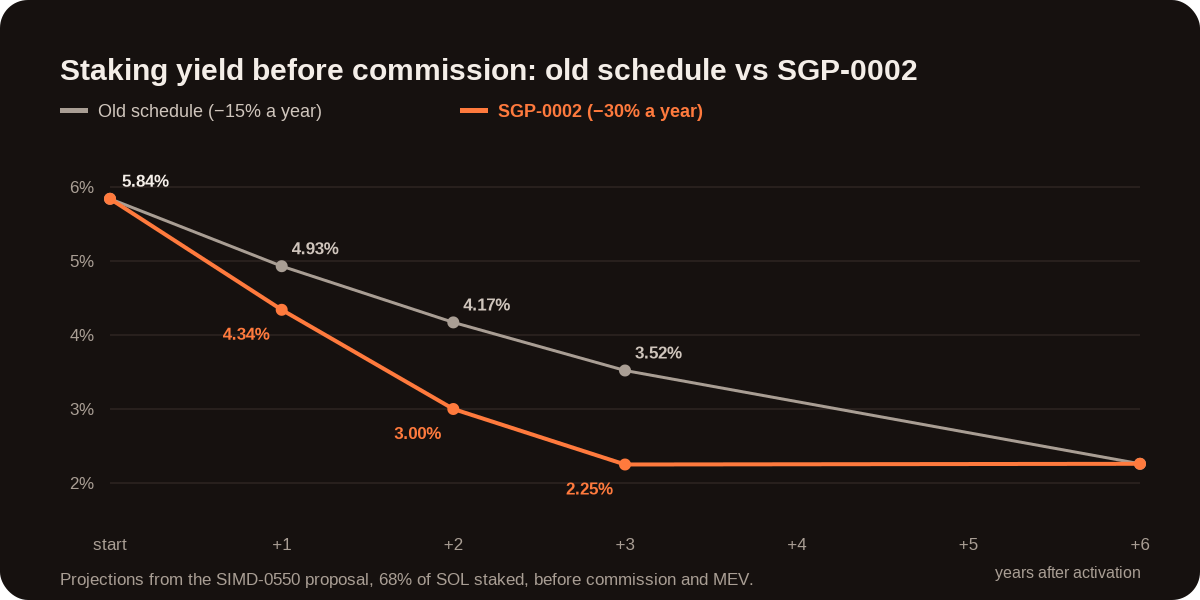
| After | Old schedule | SGP-0002 | 1,000 SOL earns per year (new) |
|---|---|---|---|
| Start | 5.84% | 5.84% | 58.4 SOL |
| 1 year | 4.93% | 4.34% | 43.4 SOL |
| 2 years | 4.17% | 3.00% | 30.0 SOL |
| 3 years | 3.52% | 2.25% | 22.5 SOL |
| 6 years | 2.26% | 2.26% | 22.6 SOL |
Two caveats. These numbers start from June 2026 levels, and inflation has already fallen a bit since. And if fewer people stake, each staker gets a bigger slice: the same projections give 4.77% after a year if only 62% is staked, and 3.98% if 74% is.
The part most headlines miss: real yield
Staking rewards are paid in newly created SOL. That new SOL also dilutes everyone, so what you really earn is the yield above inflation: the growth of your share of all SOL.
| After | Old: yield − inflation | New: yield − inflation |
|---|---|---|
| 1 year | 4.93 − 3.24 = 1.69 pp | 4.34 − 2.86 = 1.48 pp |
| 2 years | 4.17 − 2.75 = 1.42 pp | 3.00 − 1.99 = 1.01 pp |
| 3 years | 3.52 − 2.33 = 1.19 pp | 2.25 − 1.50 = 0.75 pp |
Your nominal yield after one year drops by 0.6 percentage points, but your real advantage over someone who doesn't stake drops by only about 0.2. The gap grows in later years, but it is much smaller than the headline cut. And people who don't stake are diluted less than before, which is the whole point of the change.
What it means for you
- Your SOL is safe. This changes how many new SOL are created, not anything about your stake account.
- You will see fewer SOL per epoch over time. Slowly: the rate on the day of activation is the same as the day before.
- Fees matter a little more. Commission is a percentage, so its relative effect stays the same. But MEV income doesn't depend on inflation, so as the inflation part shrinks, MEV becomes a bigger share of your reward and the MEV commission matters more. A validator with 0% MEV commission gives you more of the part that isn't shrinking.
- Be careful with "high APY" offers. As honest yields fall, scams promising 10–20% will look even more tempting. Real Solana staking won't pay that. See is Solana staking safe?
What it means for validators
Validators earn commission on the same shrinking pool, while costs stay fixed: servers, bandwidth and, since Alpenglow, a flat fee for voting every epoch. Together with the Solana Foundation retiring hundreds of validators from its delegation programme, this will push some small operators to raise commission or shut down. If you stake with a small independent validator, keep an eye on its commission; we explain what to watch in what happens to your stake when a validator leaves SFDP.
Quick answers
Will my APY drop on the day it activates? No. The curve is continuous; the change only shows up gradually over the following months.
Is it already active? No. As of 29 November 2026 no activation date has been announced.
Should I unstake? No. Staking is still the only way to avoid being diluted by inflation, and the real gap between stakers and non-stakers stays positive.
Does it change the 1.5% floor? No. The floor is the same; you just reach it sooner.
Sources: SIMD-0550 proposal, Blockdaemon's analysis.